Address
PO Box 104
4 Library Road
Middlebury, CT 06762
Contact
203-267-4717
Address
PO Box 104
4 Library Road
Middlebury, CT 06762
Contact
203-267-4717
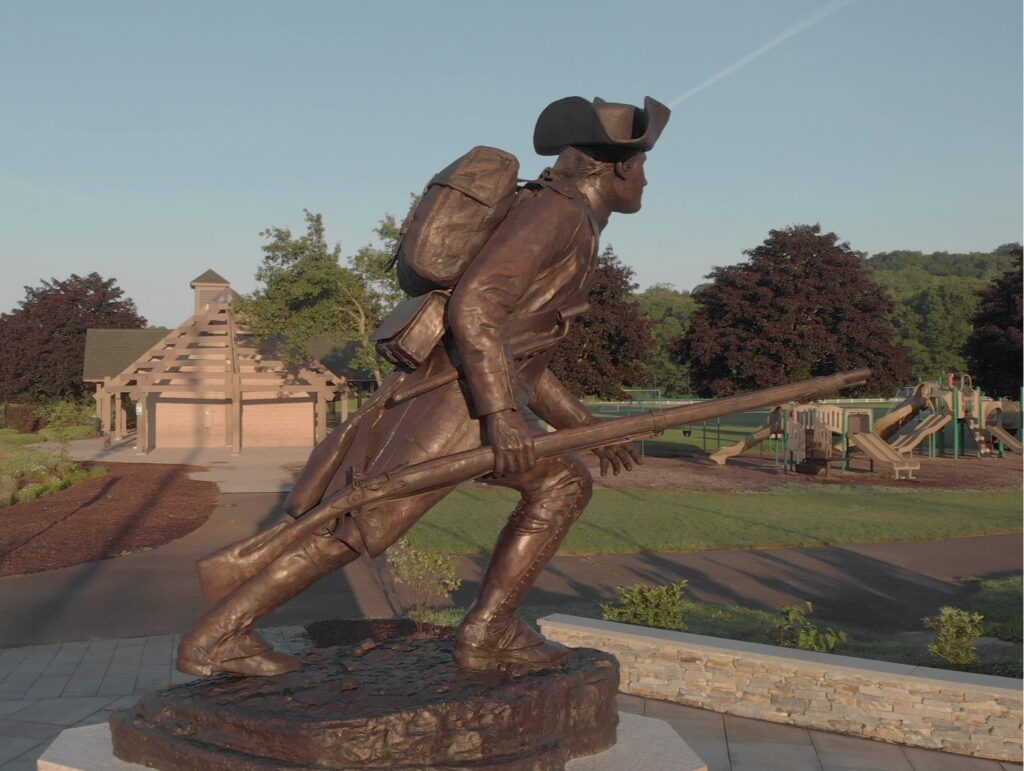
The French infantryman at Meadowview Park has been climbing the same hill since July, and he has yet to gain an inch. Leaning into his next step under the weight of his pack, he carries his musket low across his body. He is not charging into battle or posing in victory. He is simply moving forward.
The hill is Breakneck Hill, in what was then part of Waterbury, where the French army under General Jean-Baptiste Donatien de Vimeur, comte de Rochambeau, camped from June 27 through 30, 1781. The troops were crossing Connecticut to join George Washington’s army for the campaign that ended at Yorktown. Known in the French itinerary as Camp 9, the site received the army again during its return march in October 1782. For infantrymen burdened with packs, weapons and other equipment, the grade was a physical obstacle rather than a scenic backdrop. Today, their route is preserved as the Washington–Rochambeau Revolutionary Route National Historic Trail.
Middlebury marked that history long before the bronze soldier arrived. On June 27, 1904, the American-Irish Society dedicated a stone monument on a six-foot-square parcel owned by its president, Waterbury attorney Dennis H. Tierney. The inscription reads: “THE CAMP OF THE FRENCH ARMY EN ROUTE TO YORKTOWN, JUNE 27, 1781.”
The marker remains in the Breakneck Hill woods. A boulder near Artillery Road and Breakneck Hill Road identifies the approach. The original road has washed out, and reaching the monument now requires a steep woodland walk. The monument is marked, but the lack of dedicated parking makes the site difficult for many visitors.
The new memorial does not replace it. Meadowview Park offers parking, paved approaches and room for school groups and public gatherings. The woodland marker preserves the historic ground; Meadowview brings its story within reach of a wider public.
For the new memorial, Larry and Marie Janesky, whose property includes land associated with the French camp, announced a $100,000 matching challenge.
The Middlebury Historical Society originally commissioned sculptor Tony Falcone to portray Rochambeau. Falcone proposed an alternative: an ordinary French infantryman negotiating the difficult terrain. The society’s memorial committee approved the change. Falcone then developed 11 possible poses and narrowed them for the committee’s consideration. Some showed a soldier resting; others placed him upright or in motion.
During the pose deliberations, Falcone slightly favored a seated figure because military monuments seldom portray soldiers that way. Committee members ultimately chose movement over repose—the labor of the march rather than a moment of rest—and Falcone accepted the decision.
An active soldier presented another problem. Falcone recognized that several standing proposals resembled the familiar Minuteman tradition. Military artist Don Troiani, who reviewed the designs, shared that concern. Falcone wanted something specific to Middlebury, not another armed figure standing heroically on a pedestal.
The answer came from the terrain. Falcone and his wife and business partner, Judi Andrews, walked the historic Breakneck Hill ground with project patron Larry Janesky. The slope supplied both action and adversary. In Falcone’s conception, the hill became the enemy. His soldier would be determined but not advancing against another man. He would be climbing.
Troiani also provided technical guidance, recommended the model who posed for Falcone and loaned reference equipment. Falcone commissioned a custom Bourbonnais uniform and tricorner hat for the model. He then built the figure from the inside out, establishing skeleton, musculature and balance before adding the uniform and equipment. A small anatomical study made the mechanics of the stride visible: bent knees, forward lean and a body working against the grade.
The study led to a 27-inch, one-third-scale clay maquette and then to a clay figure modeled at 1.25 times life size. Molds taken from the clay were sent to the Keystone Art and Culture Center in Columbia, Pennsylvania, operated by George Mummert and Sara Barnes, where the figure was cast in bronze.
Falcone also developed renderings for a hexagonal plaza around the statue. Landscape consultant Abigail Adams of A2 Land Consulting prepared the formal site plan submitted for Planning and Zoning approval. The completed setting includes paved approaches, benches, low stone walls, flags and landscaping.
The plaza was dedicated June 27, 2026, exactly 245 years after the French army arrived. Connecticut Gov. Ned Lamont and U.S. Sen. Richard Blumenthal joined French Brig. Gen. Guillaume Ponchin at the ceremony. Foundry delays kept the statue from the ceremony; it arrived July 8 and was installed by crane.
The older monument still rewards those able to make the climb into the Breakneck Hill woods. At Meadowview Park, Falcone’s soldier makes the climb for everyone else. Together, the two monuments preserve both the place where history happened and the human effort that carried it forward.